Psychology
The Psychology tab helps you understand the mental side of your trading. Available on PRO plan only.
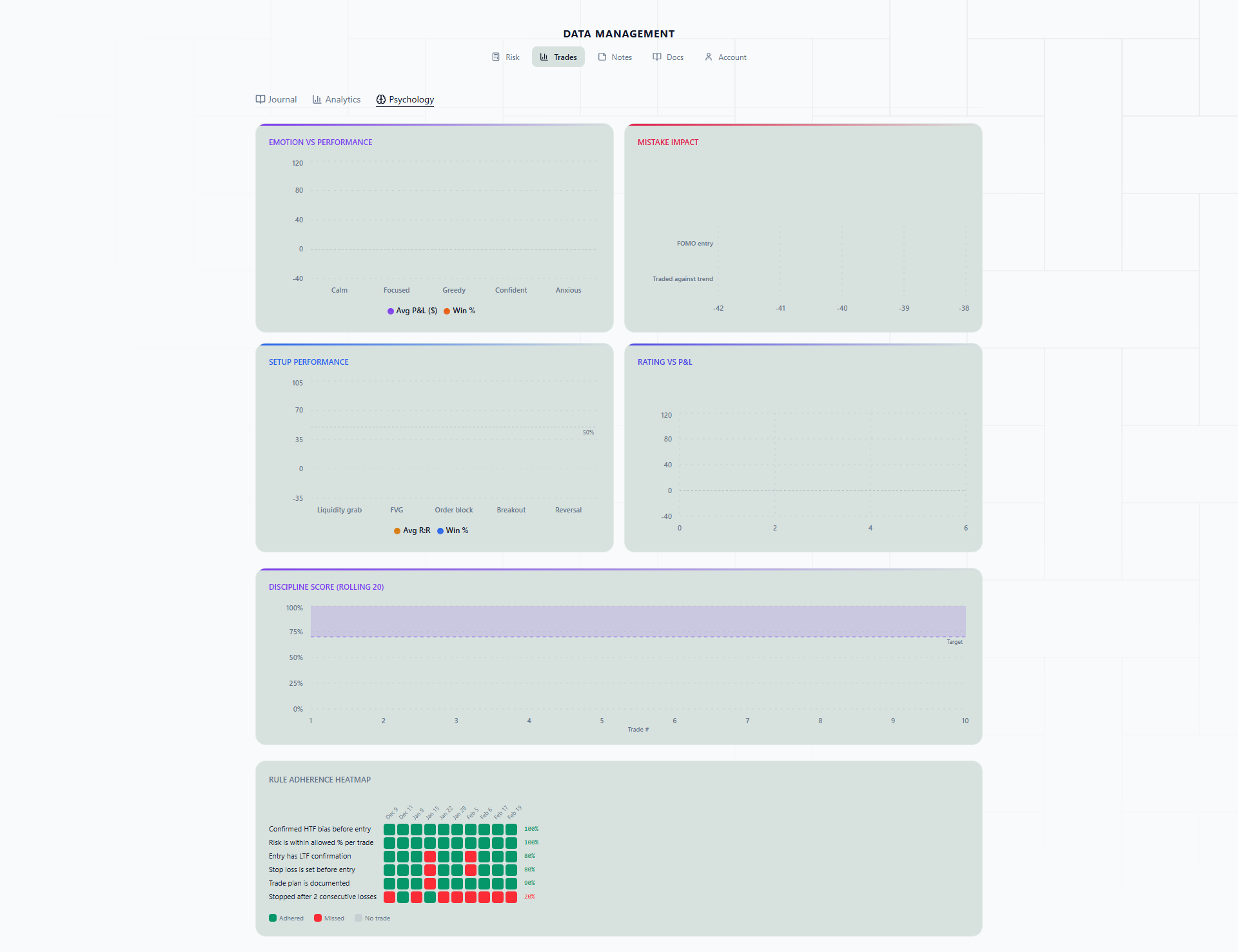
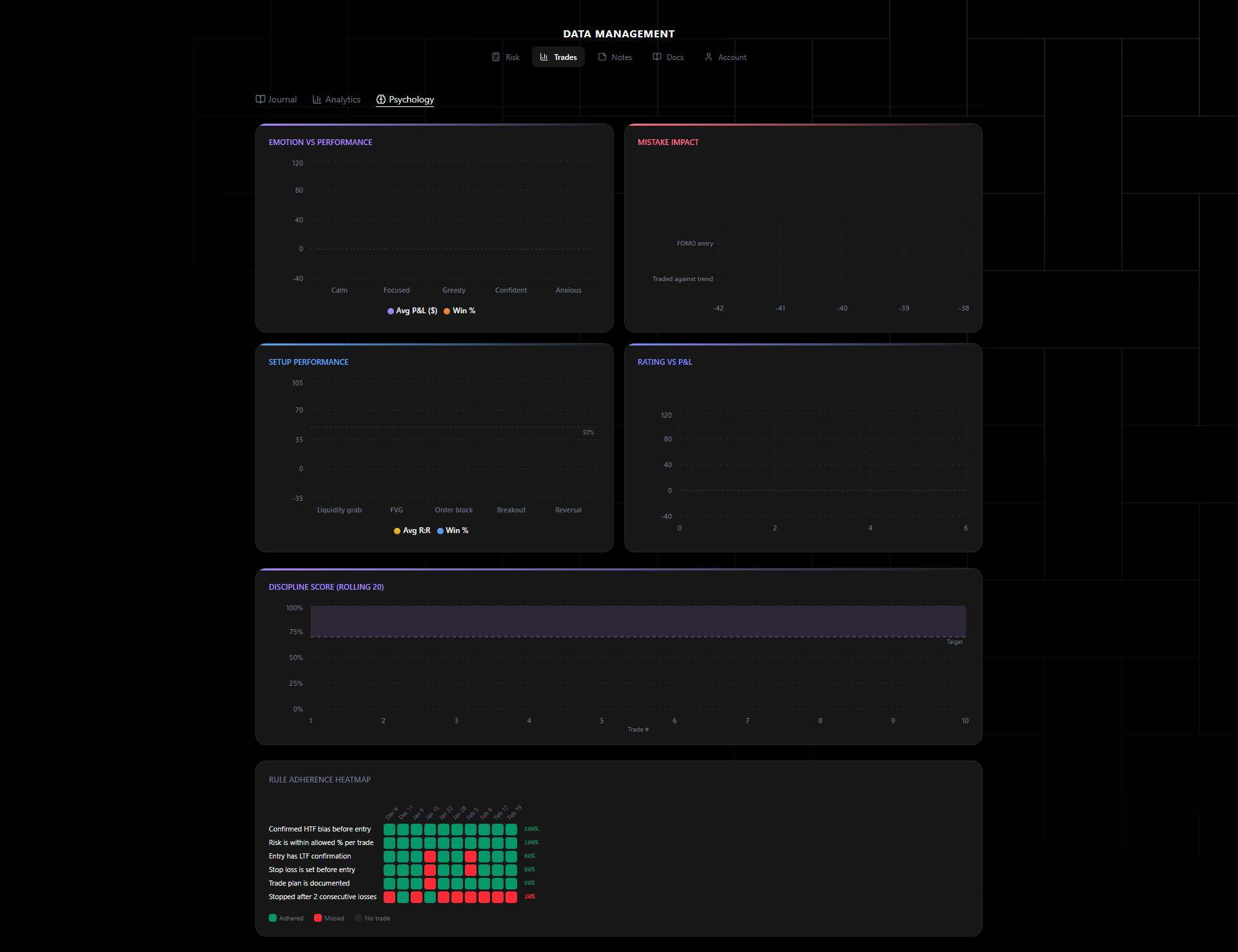
Why Track Psychology?
Ask any experienced trader what separates consistently profitable traders from the rest, and they will not say “better indicators” or “secret setups.” They will say discipline. The number-one reason traders fail is not a bad strategy — it is the inability to follow a good one.
The problem is that most traders know this in theory but have no way to measure it. You know you should not trade out of revenge. You know you should not move your stop-loss. But how much is it actually costing you? Without data, “I need to be more disciplined” is just a vague aspiration. With data, it becomes “Revenge trades have cost me $2,300 in three months, and removing them would have made February a profitable month.”
Psychology tracking turns the intangible into the measurable. It gives you a feedback loop between your emotional state, your decision-making, and your results. And once you have that feedback loop, improvement is no longer a matter of willpower alone — it is a matter of information.
Real-Life Scenarios
The revenge trading reckoning. A trader has been tagging emotions on every trade for three months. They pull up the Emotion Correlation chart and filter for “Revenge.” The results: 15% win rate, -$2,300 total P&L, 19 trades. For comparison, their “Calm” trades are running at 58% win rate and +$4,100. The revenge trades are not just unprofitable — they are actively erasing the gains from their good trades. Seeing it as a dollar figure, not just a feeling, changes the calculus. The next time they feel the urge to avenge a loss, they have a number to push back against.
The stop-loss problem you did not realize you had. A trader tags “Moved SL” as a mistake whenever they widen their stop after entry. The Mistake Impact chart reveals this one mistake accounts for 60% of all their losses for the quarter. Not 60% of mistakes — 60% of total dollar losses. Trades where they left the stop alone had a profit factor of 1.8. Trades where they moved it had a profit factor of 0.4. The fix is obvious, and now there is hard evidence to back it up.
The discipline turnaround. A trader starts with a discipline score of 45%. Not great — they are breaking their own rules on more than half their trades. But they start paying attention. They review the score weekly, identify which rules they break most often (“No trading in first 15 minutes of session” keeps getting violated), and focus on one rule at a time. Over two months, the score climbs from 45% to 78%. Over the same period, their account recovers from a drawdown that had been dragging on for six weeks. The correlation is not a coincidence.
Emotion Correlation
See how your emotional state correlates with trade outcomes:
- Win rate by emotion (e.g., “Confident” trades win 68%, “FOMO” trades win 31%)
- Average P&L by emotion
- Frequency distribution — how often you trade in each emotional state
This is one of the most revealing charts in the entire journal. Many traders discover that their “Confident” and “Calm” trades massively outperform everything else — which means the single biggest edge they can develop is learning to only trade when they are in those states.
Configure your emotion presets in Account Settings -> Psychology Presets.
Mistake Impact
Quantify the cost of your trading mistakes:
- P&L impact per mistake type (e.g., “Moved SL” cost you $450 this month)
- Frequency of each mistake
- Trades with mistakes vs. clean trades — win rate and P&L comparison
The comparison between “clean” trades and “mistake” trades is particularly useful. If your clean trades have a profit factor of 1.6 and your mistake trades have a profit factor of 0.5, you do not need a new strategy. You need to stop making the mistakes you already know about.
Setup Performance
Track which trade setups perform best:
- Win rate by setup type
- Average RR by setup
- P&L contribution by setup
- Most and least profitable setups
This answers a question every trader should know the answer to but most do not: which of your setups actually makes money? You might run three setups — a breakout play, a pullback entry, and a range fade. Setup Performance shows you that the breakout play wins 55% of the time at 1.8R average, the pullback wins 48% at 2.2R, and the range fade wins 52% but only averages 0.9R. The range fade looks decent on win rate but it is barely breaking even. That is data you can act on.
Discipline Score
An overall score reflecting how well you follow your own rules:
- Based on rule adherence, mistake frequency, and emotional control
- Tracked over time to show improvement trends
- Weekly and monthly breakdowns
Think of the discipline score as your process grade. Your P&L tells you how much money you made. Your discipline score tells you how well you traded. In the short term, these can diverge — you can make money while being undisciplined (lucky) or lose money while being disciplined (variance). But over time, they converge. A high discipline score is the leading indicator; profitable results follow.
Custom Trading Rules
Define your personal trading rules (PRO plan):
- Create rules like “No trading before news”, “Max 3 trades per day”, “Always wait for confirmation”
- Mark each trade as rule-compliant or rule-breaking
- Track adherence percentage over time
- See P&L impact of rule-following vs. rule-breaking trades
Configure your rules in Account Settings -> Psychology Presets.
Building Your Psychology Workflow
Getting value out of psychology tracking requires a bit of setup and the right habits. Here is a practical guide to making it work.
Step 1: Set Up Your Presets
Before you start tagging trades, configure your presets in Account Settings -> Psychology Presets. Keep them specific and relevant to your actual experience.
Emotions — Pick 4-6 that you genuinely experience while trading. Good examples: Calm, Confident, Anxious, FOMO, Revenge, Frustrated, Bored. Avoid vague labels like “Good” or “Bad” — they do not give you actionable data.
Mistakes — List the specific things you do wrong, not general categories. “Moved SL to avoid loss” is better than “Bad risk management.” “Entered without confirmation candle” is better than “Bad entry.” Aim for 4-8 concrete mistakes.
Rules — Write rules that are specific and binary (yes or no, you followed it or you did not). “Trade with discipline” is useless. “Do not take more than 3 trades per session” is measurable. “Always wait for the candle to close before entering” is clear. Start with 3-5 rules. You can add more later.
Step 2: Tag at the Right Time
Tag your emotion and any mistakes immediately after closing a trade — not at the end of the day, not the next morning. Your memory of how you felt during a trade degrades fast. If you wait until the evening to tag 6 trades, you will default to “Calm” for most of them because you cannot remember anymore. That defeats the purpose.
Mistakes are even more time-sensitive. Right after a loss, you know exactly what went wrong. Two hours later, your brain has already started rationalizing it.
Step 3: Review Weekly
Set aside 10 minutes each weekend to look at your Psychology tab. The key questions:
- Which emotions dominated this week? If “Anxious” or “FOMO” show up frequently, something in your environment or routine needs to change.
- Did any single mistake type cost more than the others? Focus on eliminating that one first.
- How did your discipline score trend? Improving, declining, or flat?
Step 4: Focus on One Improvement at a Time
Do not try to fix everything at once. If your data shows that “Moved SL” is your most costly mistake, make that your sole focus for the next two weeks. Tape a note to your monitor if you have to. Once that habit is fixed, move to the next one.
This incremental approach works because it is sustainable. Trying to overhaul your entire psychology in one week leads to burnout and abandonment. Fixing one concrete habit every two weeks leads to a fundamentally different trader in six months.